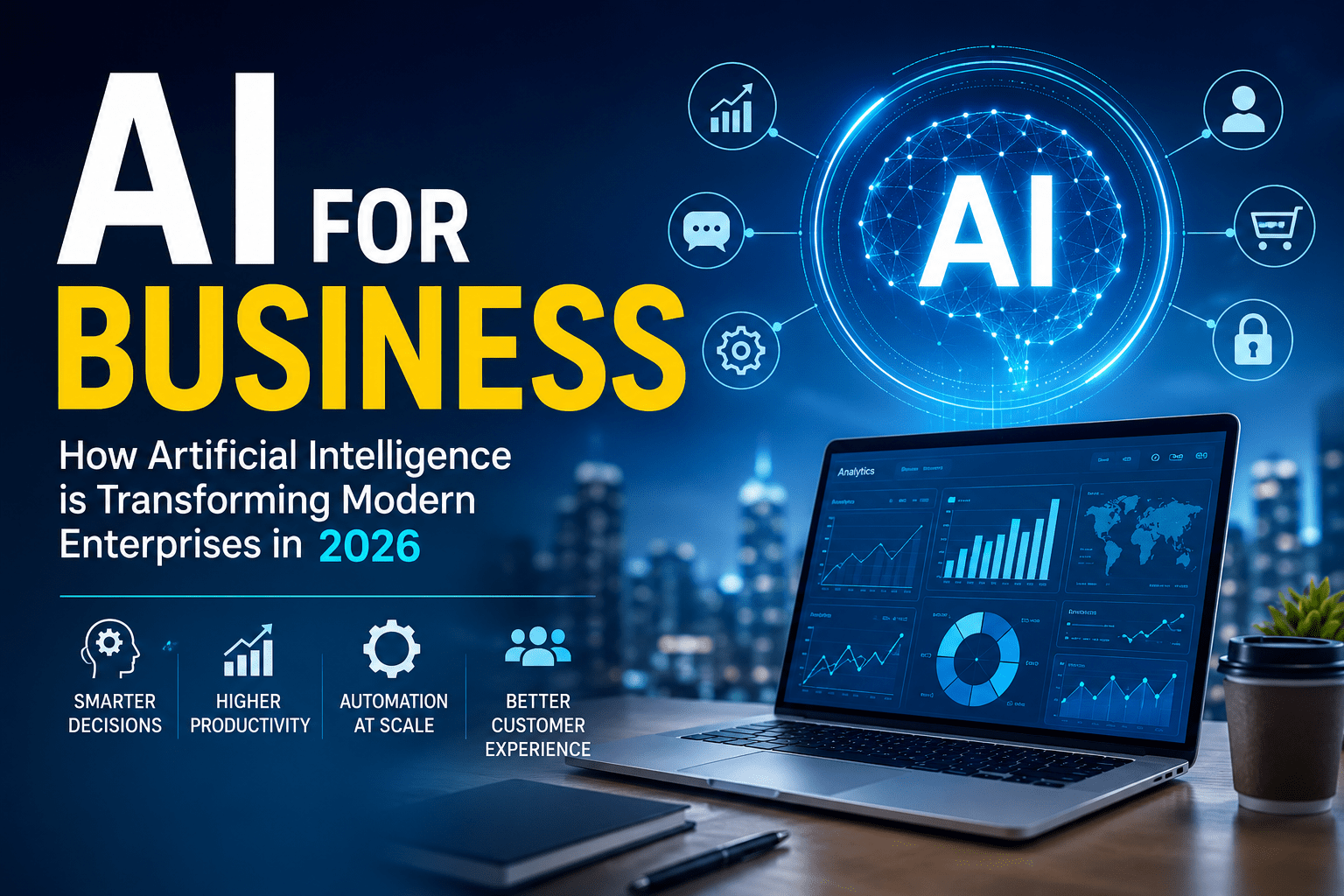
Introduction: AI for Businesses
Artificial Intelligence (AI) is no longer a futuristic concept reserved for technology giants. Today, businesses of every size—from startups and small enterprises to multinational corporations—are leveraging AI to improve efficiency, reduce operational costs, enhance customer experiences, and make smarter decisions.
The rapid evolution of AI has fundamentally changed how organizations operate. Tasks that once required hours of manual effort can now be completed in minutes. Customer inquiries are answered instantly by intelligent chatbots. Marketing campaigns are optimized using predictive analytics, while AI-powered software identifies trends hidden within massive datasets.
For business leaders, understanding AI is no longer optional—it is a strategic necessity. Companies that embrace AI today are positioning themselves for long-term growth, while those that delay adoption risk falling behind more agile competitors.
This guide explores how AI is reshaping businesses, the benefits it offers, practical use cases, challenges to consider, and how organizations can successfully integrate AI into their operations.
What Is Artificial Intelligence?
Artificial Intelligence refers to computer systems capable of performing tasks that traditionally require human intelligence. These include:
- Learning from data
- Understanding language
- Recognizing images
- Making predictions
- Solving complex problems
- Automating repetitive work
Modern AI combines machine learning, natural language processing, computer vision, and advanced data analytics to create intelligent business solutions.
Rather than replacing human expertise, AI is increasingly becoming a powerful partner that helps employees work faster, make informed decisions, and focus on high-value activities.
Why Invest in AI for Businesses
Organizations are investing billions of dollars in AI because it delivers measurable business value.
Some of the biggest drivers include:
Increased Productivity
Routine administrative tasks consume valuable employee time. AI automates data entry, scheduling, document processing, report generation, and customer communications, allowing teams to focus on innovation and strategy.
Better Decision Making
AI analyzes enormous volumes of information in seconds. Business leaders gain insights based on real-time data instead of assumptions, enabling more confident strategic decisions.
Lower Operating Costs
Automation reduces manual labor, minimizes errors, and improves operational efficiency. Businesses often experience significant savings after implementing AI-powered workflows.
Enhanced Customer Experience
Customers expect fast responses and personalized experiences. AI helps businesses provide 24/7 support, personalized recommendations, and faster service.
Real-World Business Applications of AI
Customer Service
AI-powered chatbots answer customer questions instantly, reducing wait times while improving satisfaction.
Benefits include:
- 24/7 support
- Faster response times
- Lower support costs
- Multilingual communication
- Automatic ticket routing
Marketing and Sales
Marketing has become increasingly data-driven.
AI helps businesses:
- Identify ideal customers
- Personalize email campaigns
- Predict buying behavior
- Optimize advertising budgets
- Generate marketing content
- Improve SEO performance
Sales teams also use AI to prioritize leads, forecast revenue, and identify upselling opportunities.
Human Resources
HR departments use AI throughout the employee lifecycle.
Examples include:
- Resume screening
- Candidate matching
- Employee onboarding
- Training recommendations
- Performance analytics
- Workforce planning
Recruiters can spend more time engaging with qualified candidates rather than reviewing thousands of resumes manually.
Finance
Financial departments use AI for:
- Fraud detection
- Expense management
- Invoice processing
- Budget forecasting
- Risk analysis
- Cash flow prediction
AI helps improve financial accuracy while reducing manual processing time.
Supply Chain Management
AI improves supply chain efficiency by predicting demand, optimizing inventory levels, and identifying potential disruptions before they occur.
Companies can reduce waste while maintaining product availability.
Manufacturing
Manufacturers increasingly rely on AI for:
- Predictive maintenance
- Quality inspections
- Robotics
- Production scheduling
- Equipment monitoring
This minimizes downtime while increasing production efficiency.
AI and Business Intelligence
Business Intelligence (BI) has evolved significantly with AI integration.
Traditional reporting focused on historical data.
AI-powered analytics can now:
- Predict future trends
- Detect unusual patterns
- Recommend actions
- Generate automated reports
- Visualize complex information
Executives gain actionable insights instead of simply viewing historical statistics.
Benefits of AI for Small Businesses
Many people assume AI is only for large enterprises.
In reality, cloud-based AI tools have made advanced technology affordable for small and medium-sized businesses.
Small businesses can use AI for:
- Social media management
- Email marketing
- Customer support
- Appointment scheduling
- Accounting
- Inventory management
- Website personalization
Affordable AI solutions allow smaller organizations to compete with larger competitors.
Challenges Businesses Should Consider
While AI offers enormous advantages, successful implementation requires careful planning.
Data Quality
AI systems rely on accurate, reliable data.
Poor-quality data leads to poor predictions and inaccurate recommendations.
Employee Adoption
Employees may hesitate to adopt new technologies.
Organizations should invest in training and clearly explain how AI supports employees rather than replacing them.
Privacy and Security
Businesses handling sensitive customer information must ensure AI solutions comply with privacy regulations and cybersecurity best practices.
Ethical Considerations
Responsible AI includes:
- Transparency
- Fairness
- Accountability
- Bias reduction
- Human oversight
Organizations should regularly evaluate AI systems to ensure ethical decision-making.
Steps to Successfully Implement AI
Business leaders should approach AI strategically.
1. Identify Business Problems
Start with challenges that consume time or resources.
2. Set Clear Objectives
Define measurable goals such as reducing costs, improving customer satisfaction, or increasing sales.
3. Choose the Right AI Tools
Select solutions that align with your business size, industry, and budget.
4. Prepare Quality Data
Organize and clean your business data before implementation.
5. Train Employees
Provide education so employees understand how AI improves workflows.
6. Measure Results
Track KPIs to evaluate ROI and identify opportunities for improvement.
Emerging AI Trends for Businesses
AI continues to evolve rapidly.
Business leaders should monitor trends such as:
- AI-powered virtual assistants
- Autonomous business processes
- Predictive analytics
- Hyper-personalized customer experiences
- AI cybersecurity
- Intelligent automation
- AI-generated business reports
- Voice-enabled business applications
- AI-powered coding assistants
- Industry-specific AI platforms
Companies that stay informed can adopt new technologies before competitors.
Will AI Replace Human Jobs?
This remains one of the most frequently asked questions.
The reality is more nuanced.
AI automates repetitive and predictable tasks, but creativity, leadership, empathy, negotiation, and strategic thinking remain uniquely human strengths.
Instead of replacing professionals, AI is creating opportunities for people to focus on higher-value work.
Organizations that combine human expertise with AI capabilities are likely to achieve the greatest success.
The Future of AI in Business
The future belongs to organizations that embrace intelligent technology responsibly.
AI will continue to become more accessible, affordable, and integrated into everyday business operations.
From customer service and marketing to finance and manufacturing, AI is enabling businesses to work smarter, innovate faster, and compete more effectively.
Business leaders who invest in AI education, build strong data foundations, and adopt ethical AI practices will be well-positioned to thrive in an increasingly digital economy.
Conclusion
Artificial Intelligence is transforming modern business at an unprecedented pace. It empowers organizations to improve efficiency, enhance customer experiences, reduce costs, and make data-driven decisions with confidence.
Whether you’re leading a startup, managing a growing enterprise, or overseeing a global organization, AI should be viewed as a strategic business partner rather than simply another technology investment.
The question is no longer whether businesses should adopt AI—it is how quickly they can implement it effectively and responsibly. Companies that embrace AI today are preparing themselves for a more competitive, innovative, and resilient future.