Introduction
In today’s digital age, a website’s performance and user experience are crucial for business success. Whether it’s an e-commerce store, a content portal, or a SaaS platform, users expect fast, seamless, and reliable interactions. Even minor delays or outages can lead to customer frustration, lost revenue, and damage to brand reputation. To maintain a high-quality user experience, organizations employ various monitoring techniques – among which synthetic monitoring has emerged as a powerful tool. We’ll explore what synthetic monitoring is, how it works, and why it plays a critical role in enhancing website performance and delivering an excellent user experience.
Definition
Synthetic monitoring is a proactive technique used to simulate user interactions with a website or application by running scripted tests at regular intervals. It helps identify performance issues, availability problems, and functionality errors before real users are affected, ensuring a seamless and reliable user experience.
What is Synthetic Monitoring?
A proactive method of tracking website performance is synthetic monitoring, sometimes referred to as active monitoring. Unlike real user monitoring (RUM), which collects data from actual visitors interacting with a site, synthetic monitoring simulates user interactions through automated, scripted tests. These tests run from various locations and devices at scheduled intervals to check website availability, response time, functionality, and other key performance metrics.
Think of synthetic monitoring as a continuous “health check” for your website, performed by virtual users that mimic real-world browsing and transaction behaviors. This helps IT teams identify issues before real users are affected, ensuring the site remains reliable and responsive.
How Synthetic Monitoring Works
Synthetic monitoring technologies mimic user actions like these using scripts or bots:
- Loading a web page
- Logging in and out
- Performing searches
- Adding items to a shopping cart
- Completing a checkout process
These scripts run repeatedly, often from multiple geographic locations, providing data on various performance indicators including:
- Page load times
- Time to first byte (TTFB)
- DNS resolution time
- Server response time
- Availability and uptime
- Functional correctness of workflows
The synthetic monitoring platform collects and aggregates this data into dashboards and alerts, enabling teams to track trends, diagnose issues, and optimize website performance.
Benefits of Synthetic Monitoring for Website Performance
1. Proactive Issue Detection and Resolution
One of the greatest advantages of synthetic monitoring is its proactive nature. Because tests run continuously and independently of user traffic, teams can detect outages, slowdowns, or errors early. For example, if a critical page takes longer than expected to load or a payment gateway is unresponsive, the monitoring system immediately triggers alerts for rapid investigation.
By catching problems before users encounter them, businesses reduce downtime and avoid negative impacts on revenue and customer satisfaction.
2. Comprehensive Coverage of Critical User Journeys
Synthetic monitoring can be customized to replicate the most important user workflows. This means organizations can continuously test key processes such as product browsing, user registration, checkout, and content consumption.
This level of control ensures that even less common but critical user interactions are validated regularly, unlike real user monitoring, which only captures data when actual users perform those actions.
3. Consistent and Repeatable Testing
Since synthetic tests follow predefined scripts, they provide consistent, repeatable data points over time. This uniformity makes it easier to compare performance metrics across different days, weeks, or after changes like software updates, infrastructure migrations, or content deployments.
It allows IT teams to establish performance baselines, identify regressions, and verify that fixes or optimizations have the desired effect.
4. Performance Benchmarking Across Locations and Devices
User experience varies depending on geographic location, network conditions, and device types. Synthetic monitoring tests can be run from multiple locations worldwide and on different device configurations, simulating real user environments.
This helps companies understand how their website performs for users in different markets or on mobile versus desktop, allowing targeted improvements such as optimizing CDN configurations or responsive design adjustments.
5. Validation of Third-Party Services and APIs
Many websites rely on third-party services like payment gateways, analytics platforms, or ad networks. Synthetic monitoring can verify the availability and response time of these external dependencies to ensure they don’t negatively impact the user experience.
For example, a slow or failing payment processor detected via synthetic tests can be promptly addressed to avoid losing customers at checkout.
How Synthetic Monitoring Enhances User Experience
1. Faster Load Times and Reduced Latency
By continuously measuring page load times and response metrics, synthetic monitoring provides actionable insights to speed up a website. For example, teams may discover that certain resources load slowly or that backend APIs cause bottlenecks. Fixing these issues results in faster pages, which directly correlates with improved user satisfaction and engagement.
2. Reliable Availability and Uptime
Nothing frustrates users more than encountering a broken site or error pages. Synthetic monitoring detects outages and failures immediately, so businesses can restore service quickly and minimize downtime.
3. Seamless User Interactions
By testing critical user flows end-to-end, synthetic monitoring guarantees that all website features function correctly. Whether it’s form submissions, search functionality, or payment processing, the technology verifies that users can complete tasks smoothly without errors or interruptions.
4. Improved Mobile and Global Experience
Since synthetic monitoring can simulate diverse device types and international locations, it helps tailor the website experience for a wide audience. Businesses can identify performance gaps on mobile devices or in regions with slower internet speeds and implement targeted optimizations.
Implementing Synthetic Monitoring: Best Practices
- Define critical user journeys: Identify key workflows and transactions that impact business goals and prioritize monitoring those paths.
- Test from multiple locations: Run tests globally to capture geographic performance differences and optimize accordingly.
- Include diverse devices and browsers: Simulate various user environments, including mobile, desktop, and different browser versions.
- Set meaningful thresholds and alerts: Customize performance benchmarks and alerting rules to avoid alert fatigue while ensuring important issues are flagged promptly.
- Correlate with real user monitoring: Use synthetic monitoring alongside RUM to get both proactive and reactive insights.
- Regularly update test scripts: Ensure monitoring reflects the latest site changes and new features.
- Analyze historical trends: Leverage long-term data to identify performance degradations and plan capacity or architectural improvements.
Growth Rate of Synthetic Monitoring Market
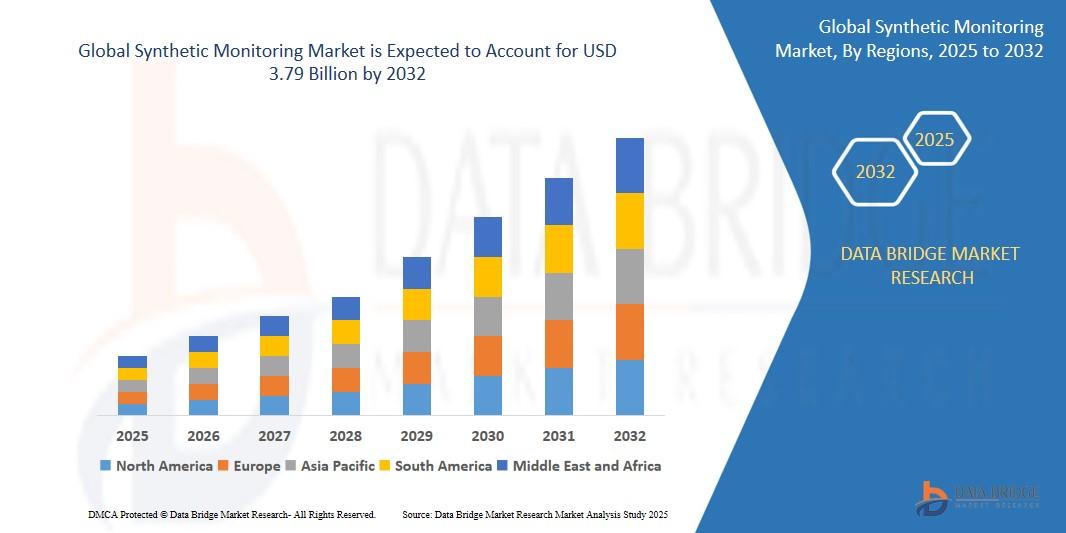
According to Data Bridge Market Research, the size of the global synthetic monitoring market was estimated at USD 1.52 billion in 2024 and is projected to grow at a compound annual growth rate (CAGR) of 12.10% to reach USD 3.79 billion by 2032.
Read More: https://www.databridgemarketresearch.com/reports/global-synthetic-monitoring-market
Conclusion
Synthetic monitoring is a vital tool for modern website performance management. By proactively simulating user interactions, it provides deep insights into availability, speed and functionality – long before real users are impacted. This proactive approach leads to faster load times, higher uptime, and seamless user experiences that boost satisfaction and business outcomes.