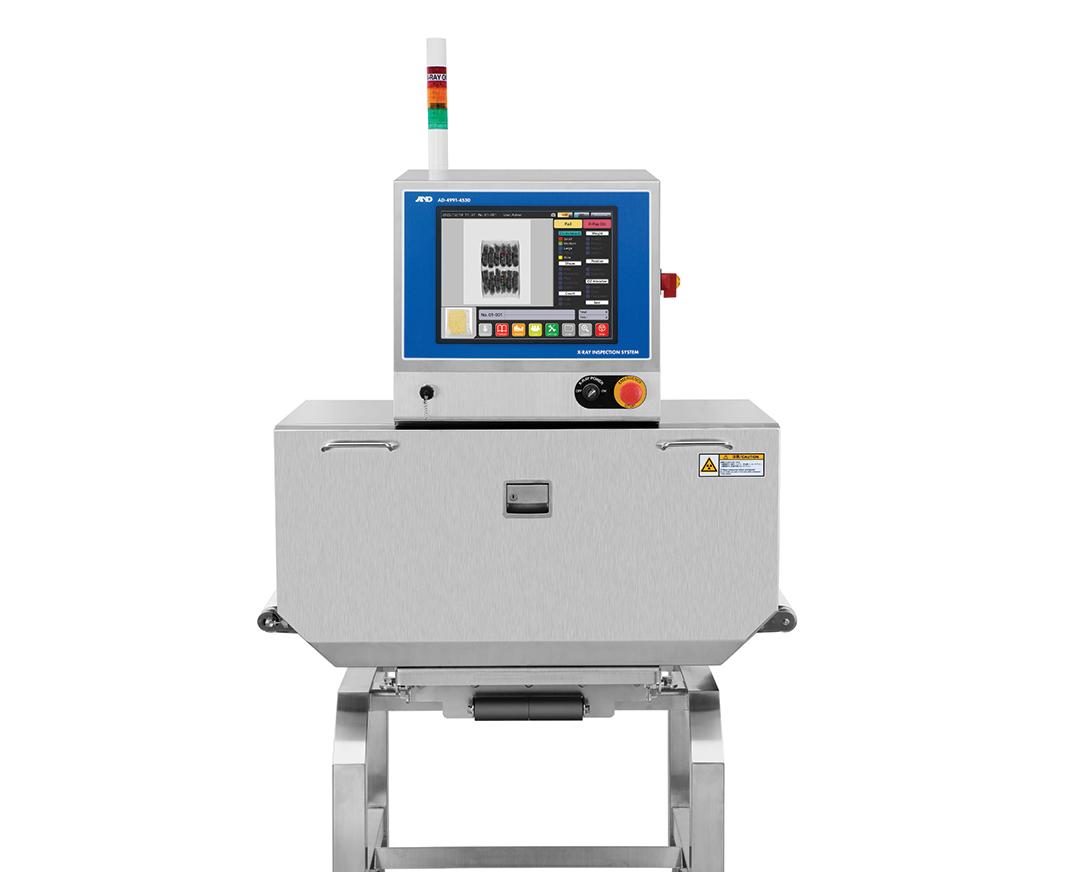
In today’s food industry, consumer safety and product integrity are non-negotiable. With increasing regulatory demands and rising consumer expectations, food manufacturers must invest in technologies that offer reliable, non-invasive inspection methods. Among the most effective of these technologies is X-ray inspection. But how exactly does it work?
1. What Are X-rays? A Primer on the Basics
X-rays are a form of electromagnetic radiation—just like visible light, radio waves, and microwaves, but with much shorter wavelengths (typically between 0.01 to 10 nanometers). Because of their high energy and short wavelength, X-rays can penetrate solid objects, a characteristic that makes them incredibly useful for internal imaging.
Discovered in 1895 by Wilhelm Röntgen, X-rays have been widely used in medicine, security, and industrial settings. In food production, their ability to detect foreign objects inside packaged or bulk food items makes them an indispensable part of modern quality control systems.
2. The Physics of Penetration: How X-rays Travel Through Food
When X-rays in food production pass through an object, they are absorbed or attenuated to varying degrees depending on the material’s density and atomic number (Z-value). Denser materials and those with higher atomic numbers absorb more X-ray energy, appearing darker or more opaque in the resulting image.
In the context of food inspection, here’s how the principle works:
- Food material (like bread, meat, or cheese) is generally low-density and allows most of the X-ray to pass through.
- Contaminants such as glass, metal, bone, or dense plastics have higher density and absorb more X-rays, making them stand out in the image as contrasting shapes or shadows.
This difference in X-ray attenuation allows inspection systems to detect foreign particles that would otherwise be invisible.
3. Key Components of an X-ray Food Inspection System
To understand the physics behind these systems, let’s examine the core components:
a. X-ray Generator (Source)
The generator emits a controlled beam of X-rays. It works by accelerating electrons toward a metal target (usually tungsten). When the high-speed electrons hit the target, their kinetic energy is converted into X-ray photons via a process called Bremsstrahlung radiation—a German term meaning “braking radiation.”
b. Conveyor System
Food products pass through the X-ray beam on a conveyor belt. The system ensures that items are consistently aligned and spaced for accurate scanning.
c. X-ray Detector
On the opposite side of the product from the generator is the detector, usually made of a scintillator material. It converts incoming X-ray photons into visible light, which is then transformed into an electrical signal by photodiodes or CMOS/CCD sensors. This signal creates a digital image representing the density profile of the scanned product.
d. Image Processing Software
Advanced software analyzes the captured images in real time, flagging any irregularities based on pre-set tolerances. The system can detect foreign bodies as small as 0.2 mm, depending on resolution and settings.
4. Interaction of X-rays with Food and Foreign Matter
Let’s explore the key interactions between X-rays and matter:
a. Photoelectric Effect
This occurs when an X-ray photon collides with an atom and ejects an electron. It’s more likely to happen with atoms that have higher atomic numbers—like metals—making them easier to detect.
b. Compton Scattering
This happens when X-rays scatter after colliding with loosely bound electrons. It provides lower contrast in imaging but still contributes to material attenuation.
c. Rayleigh Scattering
A less common elastic scattering event where no energy is lost, but it still contributes to the overall image clarity in some cases.
The balance of these effects helps generate a grayscale image that reveals contaminants even when they are embedded inside dense or irregular food matrices.
5. Factors Affecting Detection Sensitivity
The ability of an X-ray system to detect contaminants depends on multiple factors:
- Product density and uniformity: A uniform product (like a chocolate bar) is easier to scan than a complex one (like a granola mix).
- Size and shape of contaminants: Larger or denser objects are easier to spot.
- Resolution of the detector: Higher resolution means better sensitivity.
- X-ray energy (kV): Higher energy X-rays can penetrate denser materials, but may reduce image contrast.
Proper calibration and settings adjustment are critical to balance detection sensitivity with minimal false rejections.
6. Safety of X-ray Inspection in Food
A common concern is whether food exposed to X-rays becomes radioactive. The answer is no. The X-ray energy used in food inspection is not sufficient to alter the atomic structure of food. The process is:
- Non-destructive
- Non-ionizing in terms of food safety
- Completely safe for consumers and operators when proper shielding is in place
X-ray systems used in food production are also tightly regulated and must comply with international safety standards, such as those from FDA, BRCGS, and CE marking guidelines.
7. Applications Across the Food Industry
X-ray systems are versatile and used across multiple sectors:
- Meat and poultry: Detect bone fragments and metal shavings.
- Bakery: Spot stones, nuts, or glass in dough or packaged items.
- Dairy: Ensure cheese blocks and yogurt containers are free from stainless steel or plastic.
- Packaged foods: Scan for missing components, underfill issues, or broken seals.
X-ray inspection can even identify product inconsistencies such as air bubbles, clumps, or voids, enhancing not only safety but also quality assurance.
8. The Future of X-ray in Food Production
Advancements in artificial intelligence, machine learning, and 3D X-ray imaging are pushing the boundaries of what’s possible. Future systems will offer:
- Greater accuracy at faster speeds
- Automated learning of contaminant patterns
- Integration with Industry 4.0 systems for predictive maintenance
These innovations will ensure X-ray systems remain an essential component of smart food manufacturing.
Conclusion
The use of X-rays in food production is a sophisticated blend of physics and technology, designed to protect consumers and brands alike. By understanding the principles of X-ray attenuation, photon interaction, and image processing, food manufacturers can appreciate the precision and safety these systems bring to their operations. As consumer demand for safe, transparent, and high-quality products grows, X-ray inspection will continue to be a cornerstone of modern food safety.